Private Cabin Guide
Affordable Private Cabins in South Hyderabad: Pricing, Sizes, and What to Expect
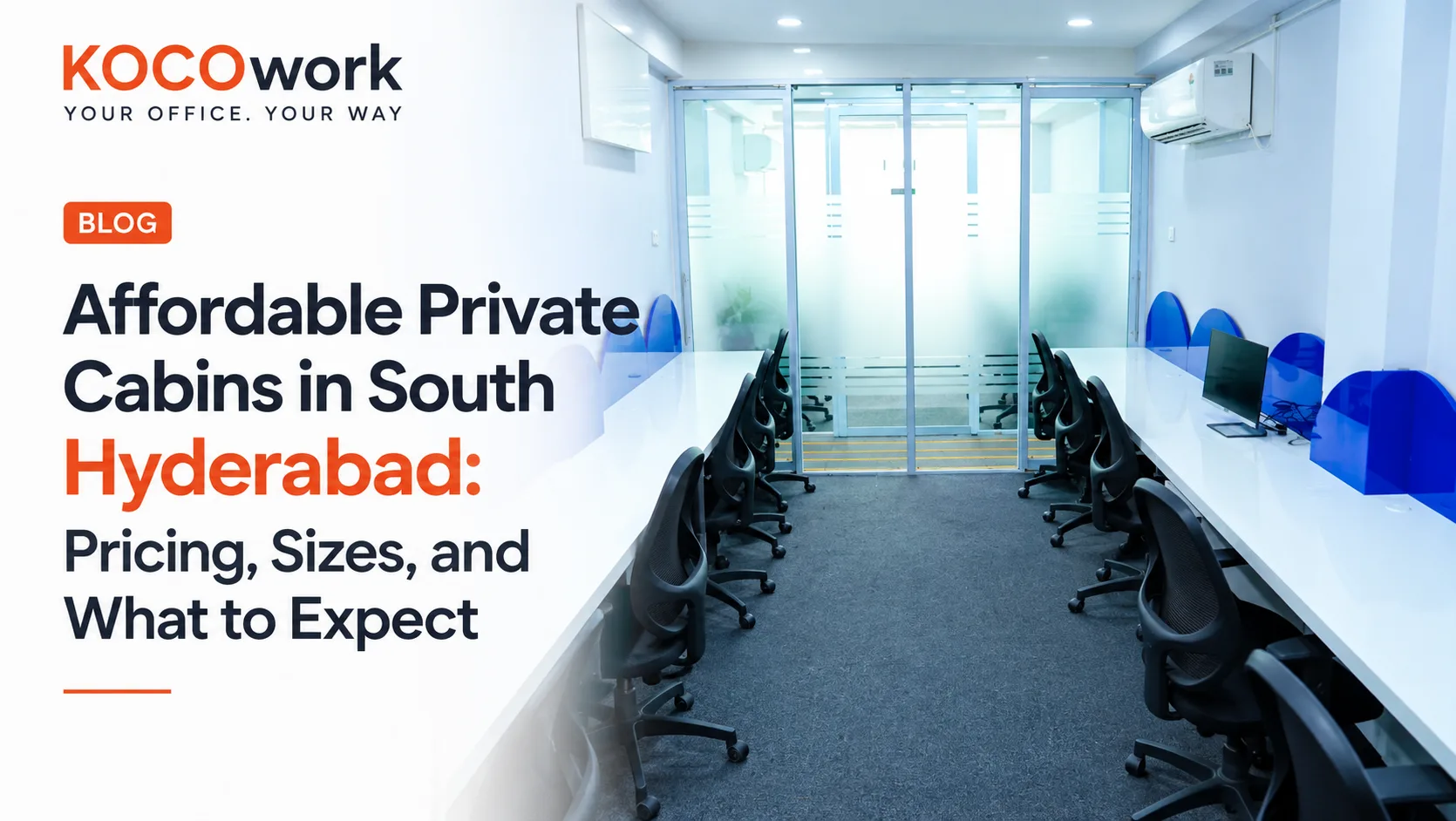
If you’re searching for a private cabin coworking Hyderabad option, you’re likely somewhere between two extremes: a home office that no longer offers enough privacy or professionalism, and a traditional private office lease that feels like overkill for your current team size. A private cabin inside a coworking space is built exactly for that middle ground — a fully enclosed, lockable space of your own, without the overhead of a standalone office.
This guide covers what private cabins actually look like, how sizing typically works, what drives pricing, and what to check before you commit to one.
Note on pricing: Specific rates vary by provider, cabin size, and location, and can change over time. Rather than quoting figures that may be outdated by the time you read this, this guide focuses on what to ask and compare. Confirm current rates directly with your shortlisted providers before deciding.
What a Private Cabin Actually Is
A private cabin is a fully enclosed, dedicated room within a coworking facility — distinct from an open hot desk or a shared dedicated desk area. It typically comes lockable, furnished, and set up for either a single professional or a small team, giving you a level of privacy and permanence that open coworking areas don’t offer, while still sharing the building’s common amenities — internet infrastructure, meeting rooms, pantry or lounge areas, and reception.
For anyone searching furnished private office Hyderabad or lockable office Hyderabad, a coworking private cabin is usually what actually meets the need — professional, secure, and move-in ready, without the months-long process of leasing and fitting out a standalone office.
The distinction from a standalone private office matters practically, not just semantically. A standalone office requires you to independently arrange internet, furniture, maintenance, security, and often reception or front-desk coverage. A private cabin inside a coworking facility inherits all of that from the building it sits within — you get the privacy of your own space plus the shared infrastructure of a professionally run facility, which is precisely the combination that makes cabins cost-effective compared to leasing an equivalent standalone space.
How Cabin Sizing Typically Works
Private cabins are generally sized around seating capacity rather than square footage alone, which makes it easier to match a cabin to your actual team size rather than guessing at floor area. Common configurations include:
1-person cabins — suited to solo consultants, CA practitioners, freelancers handling sensitive client calls, or anyone who needs a quiet, closed-door space without sharing it with a team.
2 to 4-seater cabins — a common fit for small founding teams, two-partner practices, or a manager working alongside one or two direct reports.
5 to 6-seater cabins — appropriate for a growing small team that still wants everyone in one enclosed space rather than splitting across the open coworking floor.
Larger cabins (8-10+ seats) — for established small teams that need a dedicated, private floor presence, often paired with their own small meeting or huddle area within the cabin itself.
When comparing options tagged as office for 5 people Hyderabad or office for 10 people Hyderabad, always confirm whether the quoted capacity reflects comfortable long-term seating or a tighter maximum — a cabin rated for ten people can feel very different day-to-day depending on how generously that number was calculated.
What Actually Drives Pricing
Rather than quoting numbers that vary by provider and change over time, it’s more useful to understand the factors that typically determine what a private cabin costs, so you can evaluate any quote you receive on its merits:
Understanding these factors also protects you from a common comparison mistake: putting two cabin quotes side by side without accounting for what’s actually included in each. A slightly higher quote that bundles internet, housekeeping, and meeting room hours can easily work out cheaper in total than a lower quote that bills each of those separately — but only a factor-by-factor comparison will reveal that.
Seating capacity. This is usually the primary driver — larger cabins cost more in absolute terms, though the per-seat cost often decreases as capacity increases.
Furnishing and fit-out level. A cabin with basic desks and chairs will typically cost less than one with ergonomic seating, built-in storage, or a private meeting corner.
Location within the building. Cabins with better natural light, quieter positioning, or closer proximity to entrances and amenities sometimes carry a premium over otherwise identical spaces elsewhere in the same facility.
Included amenities. Check whether the quoted rate includes internet, electricity, housekeeping, and access to shared meeting rooms, or whether any of these are billed separately — this significantly affects what “affordable” actually means once you add everything up.
Contract length and commitment. Many providers offer better per-month rates for longer commitments, similar to how traditional leases work, though typically with far shorter minimum terms than a conventional office lease.
What “Affordable” Should Actually Mean
The word “affordable” gets used loosely in workspace marketing, so it’s worth defining it concretely for your own comparison. A private cabin is genuinely affordable relative to the alternative if it costs meaningfully less than the all-in cost of a traditional private office lease — factoring in rent, deposit, furniture, utilities, and maintenance — while still giving you the privacy and permanence you actually need.
It’s also worth comparing a private cabin against staying in an open coworking area. If your work doesn’t require confidentiality or a closed door — for instance, if you’re not handling sensitive client calls or private documents regularly — a hot desk or dedicated desk in the open floor may genuinely serve you better and cost less than a cabin you don’t fully need.
One useful test: track how often, over a normal working month, you’d actually need a closed door — confidential calls, document handling that shouldn’t be visible to others, or simply focused work without any ambient noise. If that happens most days, a cabin is likely worth the premium over open seating. If it happens only occasionally, it may be more cost-effective to stay on an open desk plan and book a private meeting room on the specific days you need real privacy.
What to Expect When You Move Into a Private Cabin
Move-in readiness. A good private cabin should be fully furnished and functional from day one — desks, chairs, and often basic storage already in place, with internet and power ready to go.
Lockable, private access. You should have exclusive access to your cabin, typically via a key or access card, separate from the shared coworking areas.
Shared amenity access. Even though the cabin itself is private, you should retain access to the building’s shared meeting rooms, pantry, lounge, and common facilities as part of your membership.
Support for scaling. If your team grows beyond your current cabin’s capacity, ask upfront how the provider handles upgrades — moving to a larger cabin should be straightforward, without penalty for outgrowing your original space.
Clarity on what’s included. Before signing, get a clear, itemized understanding of what’s bundled into the quoted rate — internet, housekeeping, meeting room hours, printing — versus what’s charged separately.
A Practical Option in South Hyderabad
For CA firms, small teams, and solo professionals across Champapet, LB Nagar, and the wider South Hyderabad corridor, a private cabin offers a genuine middle path between a home office and a full commercial lease — private, professional, and scalable as your needs change.
KOCOwork offers private cabins in a range of sizes at its Champapet location, fully furnished and ready to move into. Book a tour to see the available cabin sizes in person and get current pricing based on your team’s actual needs.
Frequently Asked Questions
What’s the difference between a private cabin and a dedicated desk?
A private cabin is a fully enclosed, lockable room, while a dedicated desk is typically a reserved seat within a shared, open coworking area — a cabin offers privacy that an open dedicated desk doesn’t.
Can I upgrade to a larger cabin later if my team grows?
Most coworking providers, including KOCOwork, support moving to a larger cabin as your team scales — confirm the process and any notice period directly with your provider.
Are meeting rooms included with a private cabin, or billed separately?
This varies by provider and plan — some include a set number of meeting room hours, while others bill separately. Always confirm this before signing.
Is a private cabin suitable for client meetings, or should I book a separate meeting room?
For a small, informal conversation, a cabin can work, but for a more formal client pitch or larger group, a dedicated meeting room is usually a better setting.