Business Scaling Guide
From Day Pass to Private Office: How Much Space (and Budget) You Actually Need at Each Stage of Growth
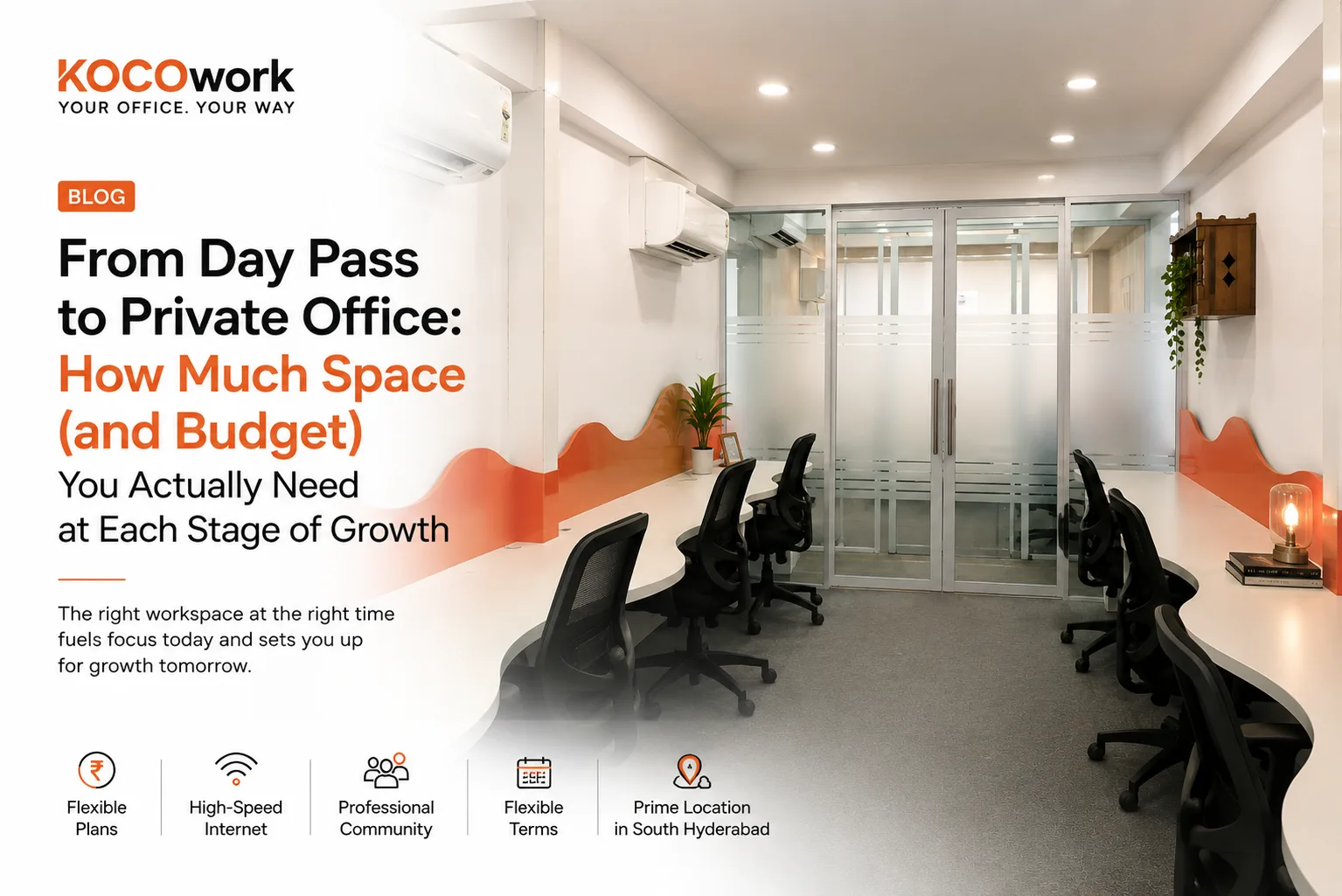
Most businesses don’t pick a workspace once. They move through several, usually without planning to, as headcount and needs change faster than any lease could keep up with.
Knowing the full path in advance — what each stage actually costs, and when it’s time to move to the next one — makes each transition a decision instead of a scramble.
Stage 1: Solo, Occasional Use
At this stage, you’re testing the waters — a founder before a team exists, or a freelancer who works from home most days but occasionally needs a professional environment.
The Day Pass fits here: ₹299 for a half day or ₹499 for a full day on an Open Desk, or ₹399 / ₹749 for a Quiet Desk if you want lower distraction. No commitment, no minimum usage.
Move on when: you’re using day passes more than 12 times a month — at that point, a monthly plan starts costing less per day.
Stage 2: Solo, Regular Use
You’re working from a coworking space most weekdays now, but don’t need the same exact desk every time.
Hot Desk (₹5,999/month) gives unlimited access to any available seat on the open floor — maximum flexibility, lower cost than a reserved desk. Hot Desk Plus (₹7,499/month) offers the same sit-anywhere flexibility on a quieter, low-density floor capped at 6 seats, for anyone who wants Hot Desk’s freedom with less noise.
Move on when: you want the same desk every day, need to leave equipment set up overnight, or want a fixed spot to build routine around.
Stage 3: Solo or Duo, Established Routine
A Dedicated Desk (₹8,999/month) reserves the same desk, every working day, with room to leave a monitor set up and personal storage included. This is the stage most freelancers, remote employees, and solo founders settle into once the routine matters more than the flexibility.
Move on when: you’re hiring your first team member and need private space for confidential calls, or the open floor no longer fits a growing team comfortably.
Stage 4: Small Team (2–4 People)
A Small Office private cabin starts at ₹17,999/month for a 2-seater, with 3 and 4-seater configurations available on request. Fully furnished, lockable, ready from day one — no fit-out, no procurement.
This is typically the first “real office” moment for a startup: a lockable door, a fixed team address, and room for confidential work that an open floor can’t offer.
Move on when: headcount crosses 4–5 people and the cabin starts feeling cramped, or you’re hiring roles that need dedicated desk space daily.
Stage 5: Growing Team (5–10 People)
A Medium Office starts at ₹34,999/month for a 5-seater, scaling up to 10 seats on request. This is where a company typically stops thinking of its office as “the founder’s cabin” and starts thinking of it as team infrastructure — enough room for a proper team meeting inside the cabin itself, not just at a booked meeting room.
Move on when: you’re past 10 people, or you need customized layouts — a manager’s cabin within the space, a reception desk of your own, a specific configuration a standard cabin doesn’t offer.
Stage 6: Established Team (10–20+ People)
A Large Office is fully custom — enterprise offices, manager cabin suites, and configurations built around exactly what a 10-to-20-plus person team needs, priced on request rather than a fixed rate. At this scale, the conversation shifts from “which plan” to “what configuration.”
The Full Path at a Glance
| Stage | Plan | Price |
|---|---|---|
| Solo, occasional | Day Pass | ₹299–749 per visit |
| Solo, regular | Hot Desk / Hot Desk Plus | ₹5,999 – ₹7,499/month |
| Solo, routine | Dedicated Desk | ₹8,999/month |
| Small team (2–4) | Small Office | From ₹17,999/month |
| Growing team (5–10) | Medium Office | From ₹34,999/month |
| Established team (10–20+) | Large Office | Pricing on request |
Budgeting Ahead
If you know your team is likely to double in the next year, it’s worth having the Stage 5 or Stage 6 conversation early — not to commit now, but to understand what the transition actually looks like and what it costs, so growth doesn’t force a rushed decision later.
What Determines the Right Time to Move Up a Stage
The pattern above is a guide, not a formula — the right time to move depends on more than just headcount. A few practical signals tend to matter more than the number itself.
- Confidentiality needs: the moment a team is handling client contracts, financial data, or hiring conversations that shouldn’t be overheard, an open floor stops being adequate regardless of team size.
- Client-facing frequency: a team meeting clients weekly benefits from a private cabin sooner than a team that never hosts anyone in person.
- Equipment and setup complexity: teams with dedicated hardware, multiple monitors, or specialized setups often move to a Dedicated Desk or Small Office earlier than pure headcount would suggest, simply because packing up daily stops being practical.
- Cultural cohesion: some founders deliberately move to a private cabin earlier than the math strictly requires, because having a defined team space — even a small one — changes how a young team operates day to day.
What Happens If You Guess Wrong
Overestimating growth means paying for a Medium Office when a Small one would do — a real cost, but a recoverable one, since moving to a smaller configuration within the same building is a conversation, not a penalty. Underestimating growth is usually the more expensive mistake: staying in a cramped Small Office past the point it’s actually working means lost productivity and friction that’s harder to quantify but just as real as an extra line item on a budget.
When in doubt, it’s generally cheaper to move one stage earlier than strictly necessary than to wait until the current stage is visibly failing.
A Note on Downsizing
This path is usually described as a growth story, but it works in reverse too. A team that shrinks — a project ends, a round of layoffs, a pivot that reduces headcount — can move down a stage the same way it moved up, without being stuck paying for space sized for a team that no longer exists. That flexibility in both directions is arguably as valuable as the ability to scale up, even though it gets discussed far less.
Why This Path Beats Signing a Lease Early
The alternative to this path is signing a traditional office lease at whatever size seems right today — and then either being locked into space you’ve outgrown, or paying for space you haven’t grown into yet. Every stage above exists within the same building, on a month-to-month or short-term basis, which means moving from one stage to the next is a conversation with our team, not a lease renegotiation or a relocation.