Coworking Community
What Actually Builds Community in a Coworking Space (Beyond Just Sharing a Floor)
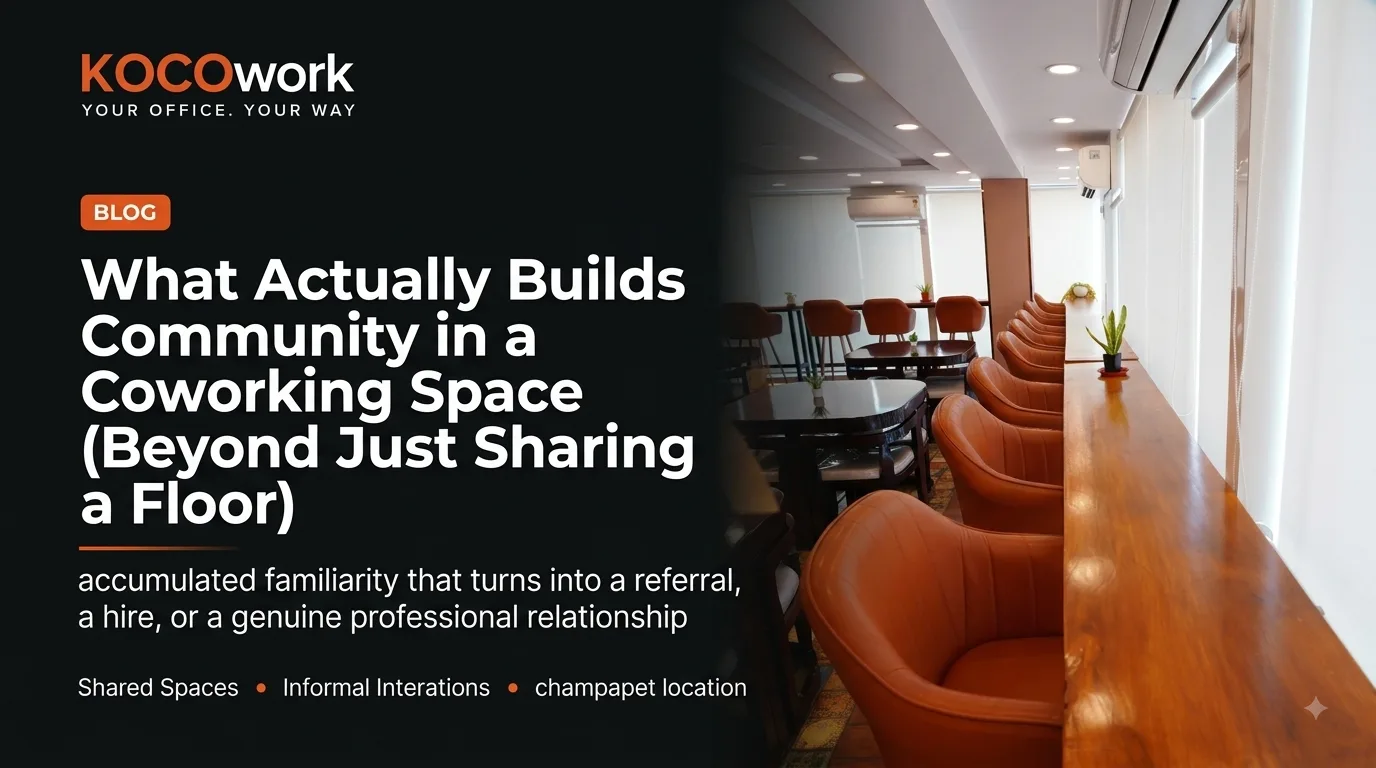
Renting a desk next to other people isn’t the same thing as being part of a community. Plenty of coworking spaces have both — and plenty have only the first.
“Community” gets used loosely in coworking marketing, often to describe nothing more specific than shared square footage. It’s worth being precise about what actually creates community, versus what just creates proximity.
Proximity Is Not Community
Sitting near other professionals is proximity. It’s a precondition for community, but not the thing itself. A space where members arrive, put on headphones, and leave without a single unplanned conversation all day has proximity and nothing more.
Community requires something proximity alone doesn’t guarantee: recurring, low-friction interaction that isn’t forced.
What Actually Creates Recurring Interaction
Shared Informal Spaces
A coffee corner, a lounge, a recreation zone — anywhere people naturally pause without a meeting scheduled — does more for community than any structured networking event. A conversation happens because two people are both getting coffee at 11 AM, not because either of them planned to network.
Repetition, Not Just Density
A space with 200 members who each show up once a month has less community than a space with 40 members who show up four days a week. Familiarity comes from seeing the same faces regularly, not from a large member count.
Staff Who Actually Know Members
Reception that recognizes a returning member, remembers their usual desk, and can make an introduction (“you two are both in fintech, have you met?”) does more community-building in a week than a scheduled mixer does in a quarter.
Shared Routines
Members who work the same hours, use the same recreation zone at the same time of day, or grab tea at the same window naturally build familiarity without either of them trying to network. Predictable overlap is what turns strangers into people you nod at, then people you talk to, then people you’d refer business to.
Consistency Over Novelty
Community-building efforts in coworking spaces tend to fail for a predictable reason: they’re treated as events rather than defaults. A quarterly mixer is novelty — it creates a spike of interaction and then nothing until the next one. A coffee corner that’s genuinely well-positioned and well-stocked works every single day, without anyone having to organize it. The unglamorous, unscheduled version usually outperforms the planned one, simply because it doesn’t depend on people remembering to show up for something.
What Doesn’t Build Community (Even Though It Looks Like It Should)
- A large member count by itself — more people without more interaction just means a busier room, not a stronger community
- One-off networking events with no informal follow-through — a single mixer creates a night of conversation, not an ongoing relationship
- Slack channels or WhatsApp groups nobody actually posts in — digital infrastructure without a reason to use it is just an unread notification
- Marketing copy that claims community without describing anything specific that produces it
How This Shows Up at KOCOwork
At KOCOwork Champapet, community isn’t a scheduled activity bolted onto a membership — it’s a byproduct of design choices that create repeated, informal interaction. The coffee corner and recreation zone are positioned as natural pause points, not optional extras tucked in a corner. Reception staff work the same shifts consistently, which means they get to know regular members rather than treating every check-in as a first meeting.
Members who use the space regularly report the same pattern described above: not scheduled networking, but accumulated familiarity that eventually turns into a referral, a hire, or a genuine professional relationship — the freelancer who meets a founder over coffee and becomes their first hire three months later, the consultant who overhears a conversation about a problem they happen to solve.
How to Evaluate This Before You Join Anywhere
- Visit at a normal working hour, not a scheduled tour time, and see whether people are actually talking to each other
- Ask how long the average member has been there — high turnover usually means low community
- Notice whether staff seem to know regulars by name
- Spend a day pass there before committing to a membership, and see whether a single unplanned conversation happens without you forcing it
The Freelancer’s Case for Community Specifically
Community matters differently depending on how you work, but it matters most acutely for people who don’t have a team around them by default — freelancers, solo consultants, and early-stage founders working without co-founders yet.
For an employee at a traditional company, professional community is largely handled by the org chart: colleagues, teams, a manager to escalate to. A freelancer has none of that structurally. The accidental conversations that happen in a well-designed coworking space — with another freelancer, a founder hiring for a role you could fill, a consultant in an adjacent field — function as a substitute for the informal professional network an employee gets automatically.
This is also why community quality matters more than desk quality for this specific group. A freelancer can replicate a good desk and fast internet at home for a fraction of the cost. What’s much harder to replicate at home is the accumulated, unplanned professional contact that a genuinely active coworking space provides.
What Community Isn’t a Substitute For
It’s worth being clear about the limits here too. Community in a coworking space is not the same as a formal professional network, a mentorship program, or a structured business development pipeline. It’s a byproduct of proximity and repeated interaction — valuable, but informal and unpredictable by nature. Anyone joining a space purely for guaranteed business outcomes from “community” is likely to be disappointed; anyone joining with realistic expectations of occasional, genuine professional connection tends to find it delivers exactly that.
For People Who’d Rather Not Be Bothered
None of this means community should feel mandatory. The people who benefit most from a well-designed shared space are often the ones who never attend a single organized event — they just happen to be present often enough, in spaces designed for pausing rather than pure heads-down work, that familiarity builds on its own. A space that only works if you actively network isn’t really solving the proximity problem; it’s just moved the effort from “find a network” to “perform networking,” which is its own kind of exhausting. The best version of this asks nothing of the people who’d rather keep their headphones on most days, while still being there for the ones who wouldn’t.
Community Beyond Business Outcomes
It’s worth separating the transactional framing — referrals, hires, client leads — from a quieter benefit that’s harder to put a number on: reduced professional isolation. Working alone, whether from home or a generic desk, has a documented cost to motivation and wellbeing over time, independent of whether it ever produces a business outcome.
Being around other working professionals, even without a single meaningful conversation on a given day, changes the baseline experience of a workday. There’s a difference between spending eight hours completely alone and spending eight hours in a room full of people also doing focused work — the second one simply feels different, in a way that shows up in mood and consistency over weeks and months, not just in any single day’s output.
This matters most for exactly the group discussed above: freelancers and solo founders who don’t have a team around them by default, and for whom the alternative to a coworking space’s community isn’t a different community — it’s no community at all during working hours.
The Honest Version
No coworking space can manufacture community on command — it emerges from repeated interaction in a well-designed shared space, or it doesn’t emerge at all. What a space can do is build the conditions that make it more likely: informal spaces worth lingering in, staff who pay attention, and enough regular members that familiarity has a chance to build.