Workspace Safety Guide
Coworking Space for Women in Hyderabad: What Actually Makes a Workspace Safe
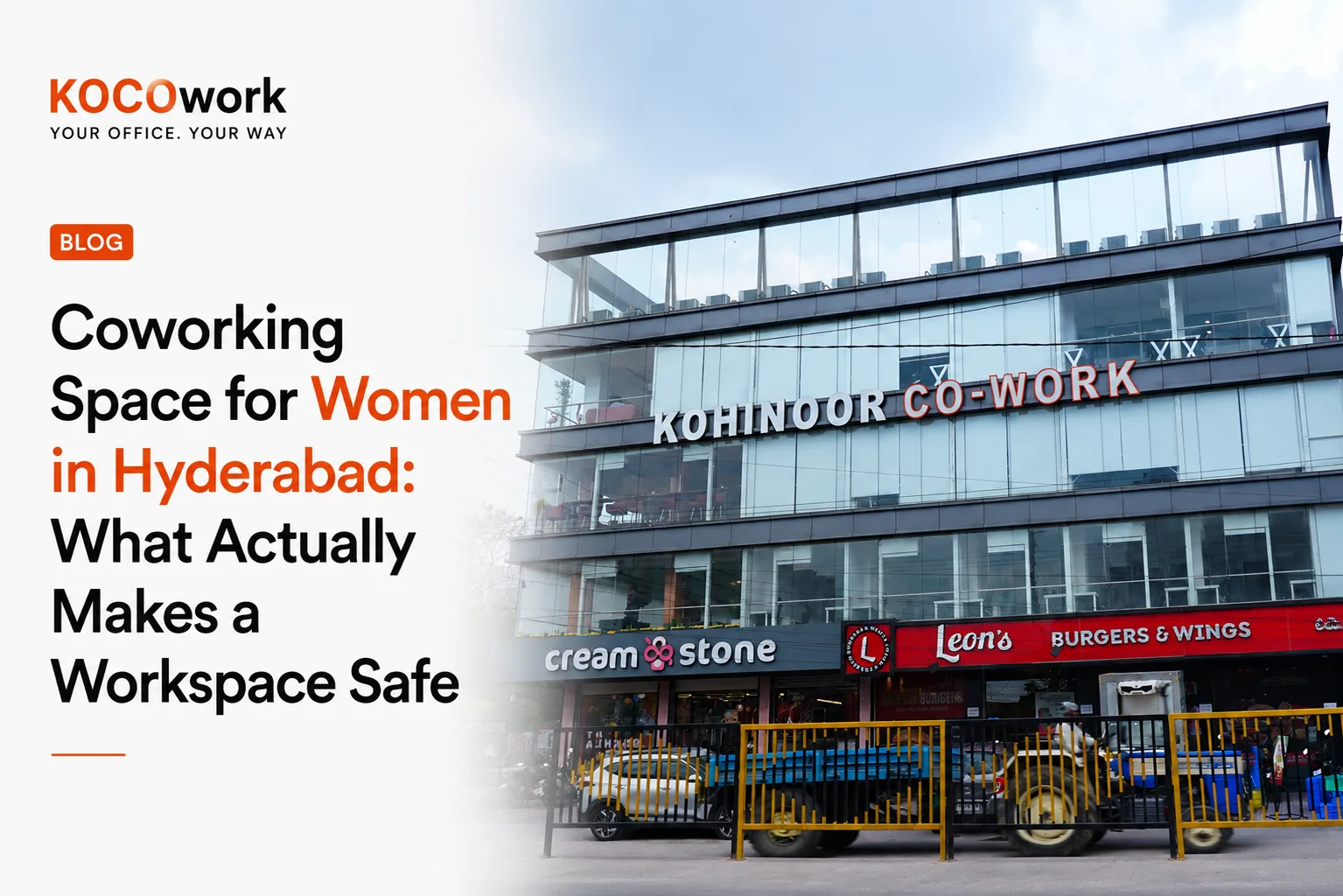
More women are freelancing, consulting, and founding businesses in Hyderabad than at any point before. For many, the workspace decision comes with a question that rarely applies the same way to their male colleagues: is this space actually safe to work from — including during early mornings, evenings, or late-night calls with international clients?
This isn’t a niche concern. It’s a practical, specific set of criteria — and it’s worth being explicit about what to actually look for.
Why “Coworking Space for Women” Is a Real Search, Not Just a Marketing Category
A quick look at what people are actually searching for shows dedicated demand: women-only coworking spaces, safe workspace for women, and women-friendly office space all show consistent search interest across Indian cities, including Hyderabad. That demand reflects a real gap — many shared workspaces weren’t designed with these questions in mind.
You don’t need a women-only space to get a safe one. You need a professionally run one, with specific features in place.
What Actually Makes a Coworking Space Safe
1. Staffed reception during operating hours
A monitored front desk does two things: it controls who enters the building, and it means someone is present if a problem arises. A coworking space with no reception — just a keycard and an empty lobby — removes both of those protections.
2. Secure, monitored access
24/7 access is a genuine convenience, but it should come with real access control — someone physically monitoring who comes in, not just an unlocked door after hours.
3. Well-lit, visible common areas
Open floor plans with good lighting aren’t just aesthetic choices. They mean no isolated corners, no dead zones in foot traffic, and no reason to feel exposed working late.
4. Private space when you want it
Not every call needs an open floor. A private cabin or a quiet desk gives you the option to take a sensitive call, work without interruption, or simply have a door between you and the rest of the room — without needing a full private office membership.
5. A professional, mixed community
A coworking space’s actual safety culture shows up in its community, not its marketing copy. Spend a day pass there. Notice who’s working late, how staff interact with members, and whether the space feels professionally run or loosely supervised.
Why This Matters More for Certain Work Patterns
Not every professional works a standard 9-to-6 day inside the same four walls. Freelancers juggling multiple clients, consultants traveling between engagements, and remote employees coordinating with international teams often work outside conventional hours — early mornings for European calls, late evenings for US-timezone teams, or irregular blocks between client meetings.
For these work patterns, a day pass matters as much as a monthly membership. It means a woman handling a 9 PM call with a US client doesn’t have to choose between working from an empty house alone or finding somewhere else that’s actually staffed and monitored at that hour. A coworking space that’s genuinely safe around the clock — not just during a 9-to-6 window — is what makes flexible, irregular work sustainable rather than a daily safety calculation.
What Good Access Control Actually Looks Like
It’s worth being specific about what “secure access” should mean in practice, because the term gets used loosely.
- A visitor process — even a simple one, like reception calling ahead before letting someone in
- Access logs that show who entered and when, even if you never need to check them
- A clear point of contact if access stops working or a door doesn’t lock properly
None of this needs to be elaborate. It needs to actually exist and be followed consistently — which is a fair thing to ask about directly before signing up, rather than assuming it’s in place.
What This Looks Like at KOCOwork
KOCOwork’s Champapet location is built around exactly these fundamentals: staffed reception, 24/7 access, an open, well-lit main floor, and private cabins and quiet desks available for anyone who wants them — not as a special request, but as a standard part of the space.
None of this is exclusive to women members. It’s simply what a professionally run coworking space should offer everyone — but it matters most, and gets asked about most, by the members who’ve had a worse experience elsewhere.
Questions Worth Asking Before You Book
- Is reception staffed, and during what hours?
- Are private cabins or quiet desks available on a day pass, or only with a full membership?
- What’s the actual foot traffic like on a weekday evening? (Best answered by visiting, not asking.)
- Is there a documented process if a member raises a safety concern?
A Practical Comparison
Setting the options side by side makes the trade-offs clearer:
| Factor | Home office | Cafe | Professional coworking |
|---|---|---|---|
| Monitored entry | No | No | Yes, staffed reception |
| After-hours safety | Depends on neighbourhood | Space typically closes early | 24/7 monitored access |
| Private space option | Yes, but isolated | No | Yes, cabins and quiet desks |
| Professional address | No | No | Yes |
| Typical cost | Hidden (electricity, isolation) | ₹700–900/day, unreliable Wi-Fi | From ₹299 (half-day) |
For Employers Providing Workspace to Remote and Hybrid Teams
This isn’t only a personal decision. Companies with remote or hybrid employees — particularly those employing women in client-facing, sales, or after-hours support roles — increasingly offer a workspace stipend or a corporate coworking membership as part of their benefits, rather than assuming a home office is the default safe option for every employee.
For an HR or operations lead evaluating this, the same criteria apply at scale: staffed reception, monitored access, and private space options aren’t just employee comfort — they’re a documented reason a company can point to when it says it took reasonable steps to provide a safe working environment for a distributed team. A day pass or dedicated desk membership at KOCOwork is straightforward to provision for a team of any size, without the overhead of negotiating a corporate lease for a handful of remote employees.
Frequently Asked
Is a women-only coworking space always safer than a general one?
Not necessarily — a mixed-professional space with strong reception, access control, and lighting can be just as safe as a women-only one; the specific features matter more than the label.
Do I need a membership to check the safety features myself?
No — a single day pass gives you the same reception, access, and floor experience as a full member, which is the most reliable way to judge a space before committing.
What should I do if something feels off during a visit?
Raise it with reception or management directly and in the moment — a professionally run space will treat that seriously; how they respond tells you most of what you need to know.
Try Before You Commit
The most reliable way to evaluate any of this is to spend a day there. A ₹299 half-day pass gets you the same reception, the same access, and the same floor that a monthly member experiences — enough to judge whether the space actually holds up to what it claims, well before you’d consider a longer membership.