Thought Leadership
Professional Workspace Infrastructure Shouldn’t Depend on Which Part of the City You Live In
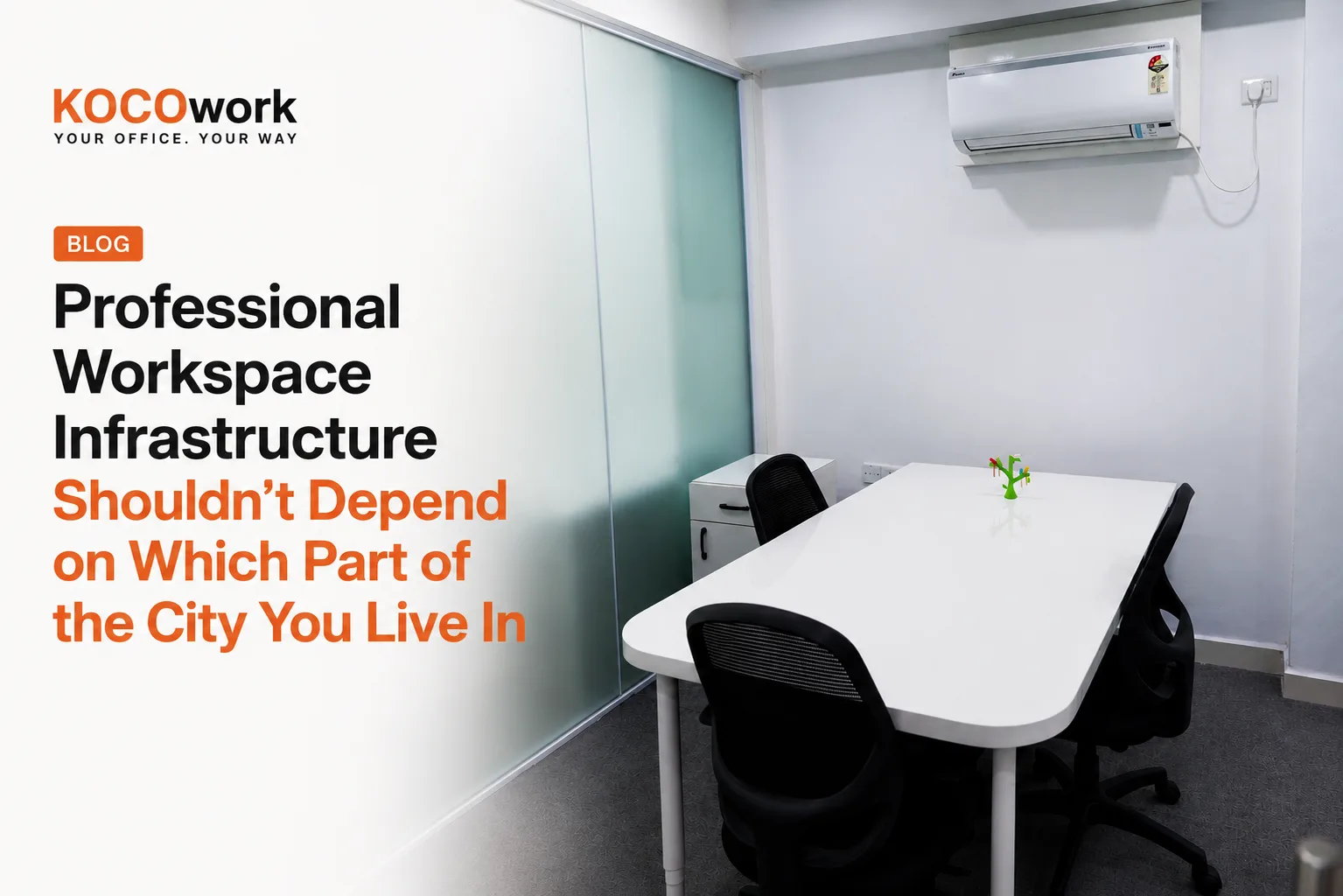
Reliable internet. A credible business address. A meeting room that doesn’t require apologizing for the background noise. A working environment built for focus rather than improvised around it.
None of this is exotic. It’s baseline professional infrastructure — the kind most businesses in established commercial districts take for granted. For a long time in Hyderabad, access to it correlated closely with proximity to a handful of neighborhoods: Hitec City, Madhapur, Gachibowli, Banjara Hills.
That correlation is the actual problem worth naming.
Infrastructure, Not Amenities
It’s worth being precise about the word “infrastructure” here, because it’s easy to lump it in with amenities — nice-to-haves that make a workspace pleasant rather than functional.
Fibre internet with a backup line isn’t an amenity; it’s the difference between finishing a client call and apologizing for one dropping. A documented, credible business address isn’t an amenity; it’s what a GST filing or a company incorporation requires. A meeting room with a proper screen and reliable AV isn’t an amenity; it’s what separates a pitch that lands from one undermined by a frozen video call.
These are the baseline requirements for operating a serious business — not luxuries reserved for whichever part of the city happened to build commercial real estate first.
Why Geography Shouldn’t Gate Access to It
A freelancer in Kothapet and a freelancer in Gachibowli have identical infrastructure needs. Neither needs less reliable internet or a less credible business address because of where they live. But for years, only one of them could access professional-grade infrastructure without a 45-to-90-minute commute.
That’s not a difference in need. It’s a difference in where infrastructure happened to get built, based on assumptions about where “serious” business activity was supposed to happen.
What Full-Service Infrastructure Actually Includes
- Connectivity: fibre internet with backup, so outages don’t become excuses
- Address: a documented, GST-and-MCA-eligible business address, not a residential workaround
- Meeting space: rooms sized and equipped for everything from a one-on-one call to a boardroom pitch
- Environment: a working space designed for a full day, not just a desk and a chair
- Reception and support: someone answering calls and handling visitors under your business’s name
- Community: proximity to other working professionals, which produces referrals and knowledge that isolated work doesn’t
None of these individually is remarkable. Together, consistently available, they constitute the infrastructure a business actually runs on.
The Metro Effect, Revisited
Hyderabad’s metro reaching LB Nagar, Uppal, and Nagole solved part of this equation — it made reaching the rest of the city faster. What it didn’t solve was the other half: having somewhere worth arriving at once you got there, or more precisely, not needing to travel at all if the infrastructure already existed locally.
Better connectivity to the city center is useful. Not needing that connectivity in the first place, because the infrastructure you need is already in your own neighborhood, is a different and arguably more valuable outcome — it doesn’t just shorten the commute, it removes the need for one on most days.
What “Full-Service” Actually Requires Operationally
It’s easy to list infrastructure components — internet, address, meeting rooms — without acknowledging what it takes to keep them running reliably. Fibre with a backup line requires a genuine second provider relationship, not just a marketing claim. Staffed reception around the clock requires an actual rotation of trained people, not an unattended desk with a sign. A credible business address requires real documentation processes behind it, not just a mailbox.
None of this is exotic, but all of it requires sustained operational effort to maintain at a consistent standard, which is part of why infrastructure like this historically clustered in a handful of commercial districts — it takes deliberate investment to build somewhere new, not just proximity to demand.
What This Has Looked Like at KOCOwork
Over the past two months, this has meant building out exactly this list at Champapet: fibre connectivity with backup, virtual office plans that cover business address, company registration, and GST registration, meeting rooms scaled from 4-seat huddles to 20-seat boardrooms, and a working environment designed around focus and recovery rather than just desks in a row.
None of it is unique to South Hyderabad in concept. What’s different is where it’s located — minutes from LB Nagar, Uppal, Kothapet, and the surrounding neighborhoods, instead of requiring a drive across the city to access it.
What Changes When Infrastructure Is Actually Local
The practical effect of local infrastructure is easy to understate until you compare it directly against the alternative. A freelancer who previously drove 45–90 minutes to reach a coworking space in Hitec City wasn’t just losing commute time — they were making a daily calculation about whether that trip was worth it, and on plenty of days, deciding it wasn’t. That decision usually meant working from home instead, with whatever infrastructure gaps that involved.
When the same infrastructure sits 15 minutes away, that daily calculation disappears. The decision to use a proper workspace stops being a special occasion and becomes the default, which is the entire point — infrastructure that’s inconvenient enough to avoid most days isn’t really functioning as infrastructure at all, no matter how good it is on the days someone makes the trip.
Who This Actually Serves
- Freelancers and consultants who need a credible client-facing environment without a daily commute eating into billable hours
- Remote employees of companies elsewhere in India or abroad, who need reliable infrastructure during their working hours regardless of what those hours are
- Early-stage founders and small teams who need a business address, meeting space, and room to grow, without the overhead of a traditional lease
- Established professionals — CAs, consultants, service providers — who’ve been operating from home or borrowed space and are ready for something more permanent
None of these groups is well served by infrastructure that exists thirty kilometers away. All of them are well served by infrastructure that exists in the neighborhood they already live and work in.
The Broader Point
This isn’t an argument that South Hyderabad deserves special treatment. It’s the opposite: professional infrastructure shouldn’t have required special treatment to reach this side of the city in the first place. The same standard that’s assumed in Hitec City — reliable connectivity, credible addresses, proper meeting space — should be the baseline everywhere professionals actually live and work.
That’s the standard this has been built around from day one, not a reduced version of what’s available elsewhere in the city.