South Hyderabad Workspace Guide
Why South Hyderabad Is Becoming Hyderabad’s Coworking Hub — And What It Means for Your Business
For years, Hyderabad’s professional workspace landscape had a clear geography.
The West was where coworking happened. HITEC City, Madhapur, Gachibowli — that’s where national chains built their spaces. If you worked anywhere else, you either commuted an hour or worked from home.
South Hyderabad — Champapet, Dilsukhnagar, LB Nagar, Uppal, Kothapet, Nagole — was treated as a residential zone, a place people lived but rarely a place they were expected to work professionally. That’s changing, and the shift is significant enough that it’s worth understanding both why it’s happening and what it actually means for the professionals living through it.
Why South Hyderabad Matters
South Hyderabad isn’t just a bedroom community. It’s where a significant portion of Hyderabad’s working professionals actually live, even if their workplace infrastructure hasn’t historically reflected that.
The demographics tell the story:
- A large number of IT professionals who commute out to corporate parks
- A significant population of freelancers and independent consultants
- A growing number of startup founders and early-stage companies
- A dense population of remote workers, serving companies based in the US, Singapore, and Australia
- A strong presence of service providers — chartered accountants, consultants, coaches, and trainers
For years, these professionals had three genuinely unsatisfying options: commute 45 to 90 minutes to HITEC City or Banjara Hills for access to a proper coworking space; work from home and quietly sacrifice professionalism and focus; or work from cafés, dealing with unreliable WiFi and no real privacy for client calls. None of these were real solutions — they were compromises people made because nothing better existed nearby.
The Metro Effect, and Why Coworking Follows It
When Hyderabad’s metro expansion connected LB Nagar, Dilsukhnagar, Uppal, and Nagole to the rest of the city, it solved one problem: getting to an office faster. But it also quietly revealed another, less obvious one — commuting faster into the city still didn’t answer where South Hyderabad professionals were actually supposed to arrive and work once they got there, if they weren’t traveling into the city at all.
The metro made movement easier. It didn’t solve the last-mile problem of professional infrastructure. That’s precisely where coworking steps in — not as a replacement for the metro’s convenience, but as the missing endpoint it never addressed.
What’s Driving the South Hyderabad Coworking Movement
- Critical mass of professionals. Enough working people now live in South Hyderabad to support dedicated workspace infrastructure. For the first time, the underlying economics genuinely make sense for a serious coworking operator to commit to the area.
- Land and real estate economics. Property in South Hyderabad is more affordable than in commercial corridors like HITEC City. This allows coworking spaces here to offer stronger pricing while maintaining real quality, rather than compromising on either.
- The “work near home” trend. Post-pandemic, professionals increasingly want workspace closer to home rather than a daily trek into a business district. A commute to HITEC City becomes considerably harder to justify once a genuinely professional alternative exists fifteen minutes away.
- Startup ecosystem growth. South Hyderabad is seeing a real, measurable increase in early-stage companies and solo founders. These businesses need professional infrastructure — a proper address, meeting rooms, reliable internet — without the overhead of a traditional office lease signed before revenue exists to support it.
The South Hyderabad Advantage: Why It Matters to You
If you’re based in South Hyderabad, this shift isn’t a minor convenience — it changes the daily arithmetic of how you work.
Commute time, compared honestly:
- To KOCOwork (Champapet): 5–20 minutes from most South Hyderabad locations
- To HITEC City coworking: 45–90 minutes
- To Banjara Hills: 60–90 minutes
This isn’t just a saving of thirty or sixty minutes a day. Across a working week, it adds up to roughly two and a half to five hours of time that would otherwise be spent entirely in transit — time that can instead go toward actual work, or simply toward not arriving home exhausted before the evening has even started.
Professional presence matters just as much as time. Instead of explaining that you work from home or a café, you have a real business address inside a professional coworking space. For freelancers, consultants, and startup founders in particular, this changes client perception immediately and without any additional effort on your part.
Neighborhood Breakdown
- LB Nagar — The southern metro terminus draws professionals from across the southern belt. For anyone based here, KOCOwork is 10–15 minutes away — closer than any other professional workspace option currently available.
- Champapet — A mix of residential and commercial development, Champapet is home to KOCOwork’s main location. The neighborhood has seen steady growth in its IT and consultant population, and functions as the accessibility hub for the entire South Hyderabad corridor.
- Dilsukhnagar — One of South Hyderabad’s busiest commercial areas, with a significant presence of CA firms, finance consultants, and small businesses.
- Uppal — The eastern edge of the developed corridor, close to IT campuses including NSL and Genpact. A growing population of startup founders and freelancers here want workspace closer than HITEC City. KOCOwork in Champapet is 15–20 minutes away — still meaningfully closer than the western alternatives.
- Kothapet — Densely residential, full of IT professionals and remote workers, and currently without any dedicated professional workspace of its own. KOCOwork Champapet is roughly 10–15 minutes away.
- Nagole — The eastern metro terminus, with a growing professional population and no local workspace option. KOCOwork is approximately 16–18 minutes away, or reachable via a metro connection to LB Nagar with a short last-mile leg.
The Competitive Advantage of Local Coworking
When you work fifteen minutes from home instead of ninety minutes away, the change isn’t incremental — it’s structural.
- You gain two or more productive hours daily
- You maintain a clearer separation between work and personal life
- You can return home for lunch and come back refreshed
- You retain the option to work from the office some days and from home on others, without either choice being forced by commute logistics
- You become part of a genuinely local professional community, rather than a sprawling regional one you rarely see in person
For startups in particular, this advantage compounds. A team can operate leaner and more efficiently when it isn’t collectively burning three to four hours a day in commute time that produces no output whatsoever.
What KOCOwork’s Presence Means
KOCOwork isn’t a branch of a national chain applying the same formula uniformly across every neighborhood it enters. It was built specifically for South Hyderabad professionals, by design rather than as an afterthought.
The location — Champapet, is strategically placed to minimize commute time for the actual working population in this part of the city. The result is a coworking space designed around how South Hyderabad professionals actually work, rather than one retrofitted from a template built for a different part of the city entirely.
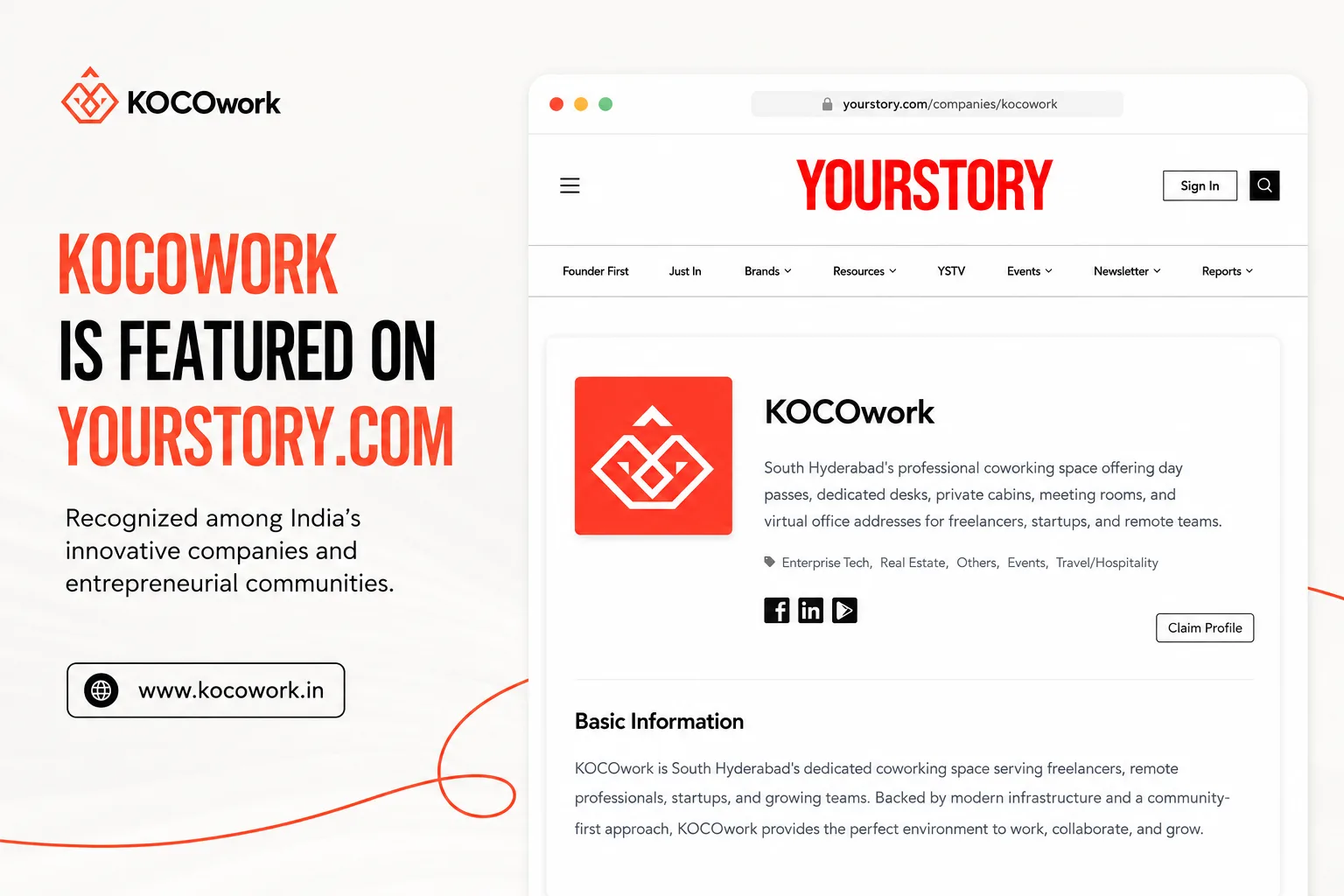
KOCOwork’s presence in South Hyderabad has also been noted in broader coverage of Hyderabad’s growing startup ecosystem, including a feature on YourStory, which has tracked the shift of professional infrastructure into previously underserved parts of the city. That coverage frames KOCOwork’s founding thesis in much the same terms outlined here: a coworking model built specifically to enter an underserved South Hyderabad market, rather than a national chain extending its existing template into a new pin code.
Why South Hyderabad Is Becoming the New Hub
The trend is clear: coworking is shifting from a West-Hyderabad-only model toward something genuinely geographically distributed. South Hyderabad now has the population density to support it, the professional diversity — IT, startups, freelancers, consultants — to sustain it, the metro connectivity to make it practically viable, the affordability to make it economical for operators and members alike, and real, accumulated demand from professionals tired of long, unproductive commutes.
For South Hyderabad professionals, the implication is simple: you no longer need to choose between working from home and commuting to HITEC City. There is now a genuine third option — professional coworking, fifteen minutes from your own neighborhood.