South Hyderabad Workspace Guide
Why South Hyderabad Is Quietly Becoming Telangana’s Next Business Hub
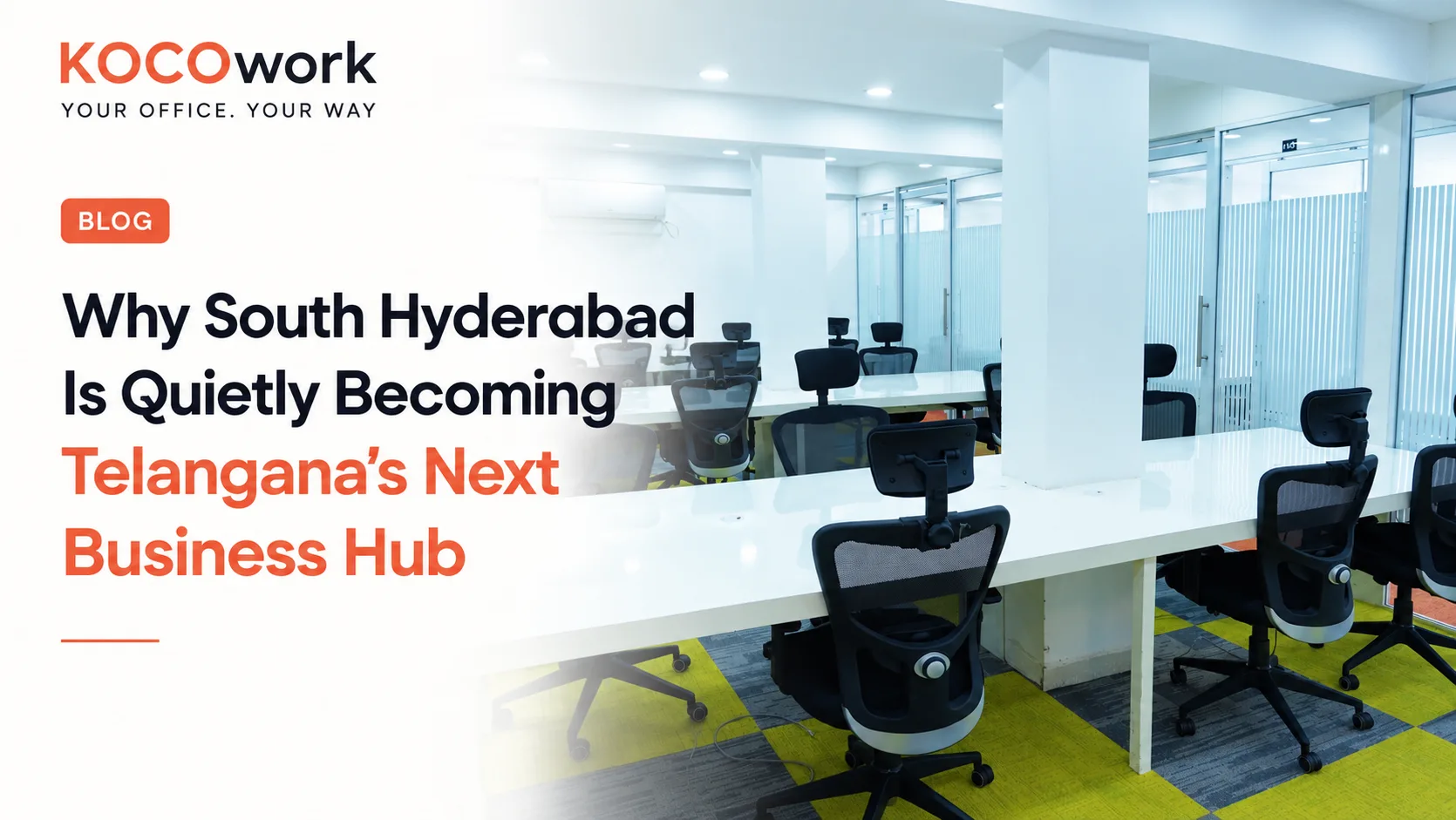
For a long time, “business Hyderabad” meant one thing: Hitec City, Gachibowli, Madhapur — the western corridor where IT parks, glass towers, and international company logos cluster together. If you wanted a serious professional address, that’s where you looked. South Hyderabad, by comparison, was where people lived, not where they worked.
That assumption is quietly falling apart.
The Numbers Behind the Shift
South Hyderabad — the corridor running through LB Nagar, Saroornagar, Chaitanyapuri, Kothapet, Champapet, Nagole, and out toward Uppal and Vanasthalipuram — has spent the last several years absorbing residential growth at a pace the western suburbs can no longer match. Land and rent in Gachibowli and Madhapur have climbed high enough that a meaningful share of the workforce commuting there every day actually lives, or would prefer to live, in the south and east of the city.
That mismatch — where people work versus where they live — used to be an accepted cost of doing business. It no longer has to be. Metro connectivity along the LB Nagar corridor has made movement across the city dramatically easier than it was even five years ago, which means the pressure to physically relocate a business or a workforce toward the west has eased considerably. When a professional can reach a client meeting or a coworking desk in South Hyderabad in a fraction of the time it would take to cross town to Hitec City, the old assumption that “real” business happens in the west starts to look outdated.
This isn’t unique to Hyderabad. Cities that grow fast enough tend to develop secondary business corridors once their primary commercial district becomes too expensive or too congested to keep absorbing demand — and the secondary corridor that emerges is almost always the one already carrying the residential density to support it. South Hyderabad fits that pattern closely.
Who’s Actually Driving This
The shift isn’t being led by large enterprises relocating headquarters. It’s being driven by something quieter and, in the long run, probably more durable: independent professionals, small teams, and service businesses that don’t need to be anywhere specific — they need to be somewhere convenient, professional, and cost-sensible.
Freelancers and consultants working for clients based anywhere in the world have no real reason to pay premium rent in the west when their actual work happens over a laptop and a video call. CA firms, accountants, and legal consultants serving a local South Hyderabad client base have every reason to set up where their clients already are, rather than asking clients to travel across the city to reach them. And small businesses formalizing their operations — registering a company, applying for GST, opening a current account — increasingly recognize that a professional business address doesn’t require a lease in Banjara Hills to be credible.
The same logic extends to small teams and early-stage startups. A founder building a five- or six-person team doesn’t need to compete for office space in the most expensive part of the city to be taken seriously by clients or investors — what matters is a professional setup, a credible address, and a workspace that supports focused work, all of which South Hyderabad’s growing coworking and virtual office infrastructure can now provide.
This is the pattern that tends to precede a genuine business hub forming: not a single anchor tenant, but a slow accumulation of independent economic activity that eventually reaches a density where infrastructure, services, and further investment start following the demand rather than leading it.
It’s worth noting how different this looks from the way Hyderabad’s western corridor developed. Hitec City and Gachibowli grew primarily around large IT and multinational anchors — big companies arrived first, and the surrounding ecosystem of housing, retail, and services followed to support them. South Hyderabad’s growth is running in something closer to the opposite direction: the residential base and the independent professional activity are already there, and the commercial infrastructure is now catching up to meet it. That’s a slower, less headline-grabbing kind of growth, but it also tends to be more resilient — it isn’t dependent on the fortunes of any single large employer.
Infrastructure Is Catching Up
Business districts don’t form in isolation — they form around infrastructure that makes work easier. South Hyderabad’s case is helped by several things converging at once: metro rail extending real connectivity into the corridor, retail and hospitality development picking up alongside residential growth, and a growing base of flexible workspace options that let businesses set up quickly without the capital commitment a traditional office lease demands.
That last point matters more than it might initially seem. A business district doesn’t need every company to build or lease a permanent office to function as a hub — it needs enough flexible, professional infrastructure that starting or scaling a business locally becomes genuinely easy. Coworking spaces, virtual office providers, and meeting room facilities are, in a sense, the connective tissue that makes a corridor like South Hyderabad viable as a business zone well before large-scale commercial real estate development catches up.
This is also where the shift becomes self-reinforcing. Once a corridor has enough flexible workspace, registered business addresses, and meeting infrastructure to support a growing base of professionals, it becomes easier for the next wave of businesses to set up there too — which in turn attracts more of the retail, food, and service infrastructure that makes an area feel like a genuine commercial district rather than just a residential one with some offices scattered through it. South Hyderabad is visibly in the early stages of that cycle.
What This Means for Local Professionals
If you’re a freelancer, small business owner, or team lead based in South Hyderabad, this shift changes the calculation that used to make sense a few years ago. The old logic was straightforward: if you wanted proximity to “real” business activity, you accepted a longer commute or a higher cost of operating out of the western corridor. That trade-off is weakening.
It’s now increasingly possible to build a fully credible, professional operation — complete with a registered business address, meeting space for client conversations, and a working environment that doesn’t feel like a compromise — without ever needing to set foot in Hitec City. For a consultant, a small agency, or a growing team, that means lower overhead, shorter commutes for staff, and proximity to a client base that, for many South Hyderabad-based businesses, was always local to begin with.
A Corridor Worth Watching
None of this means South Hyderabad is about to replace the western IT corridor as Hyderabad’s primary commercial identity — that’s not a realistic claim, and it’s not really the point. What’s happening is more specific and, for people actually working in the area, more useful: South Hyderabad is developing its own independent economic gravity, driven by residential density, improved connectivity, and a rising base of professionals who no longer see any reason to base their work somewhere else.
For businesses and professionals already anchored in the south of the city, that’s a genuinely good position to be in — not chasing a hub that’s forming elsewhere, but working from inside one that’s forming around them.
The Practical Takeaway
If you’ve been operating out of a home office or delaying the decision to formalize a business presence because the “real” business districts felt out of reach, it’s worth reconsidering that assumption. A flexible workspace in South Hyderabad — whether it’s a desk for daily work, a meeting room for client conversations, or a virtual office for registration purposes — can now offer the same professional footing that used to require a much bigger commitment and a much longer commute.
The corridor is still early in this shift, which is precisely what makes it worth paying attention to now rather than in five years, once the infrastructure and the rents have both caught up to the demand. Businesses and professionals who establish themselves here early — building client relationships, local reputation, and operational roots in the area — tend to benefit disproportionately compared to those who wait until South Hyderabad’s status as a business corridor is already common knowledge.
If you want to see what that looks like in practice, KOCOwork in Champapet is part of this same shift — built for professionals who’d rather work close to where they actually live and do business. Book a tour to see the space for yourself.