Virtual Office Guide
Business Address, Company Registration, or GST — Which Virtual Office Plan Do You Actually Need?
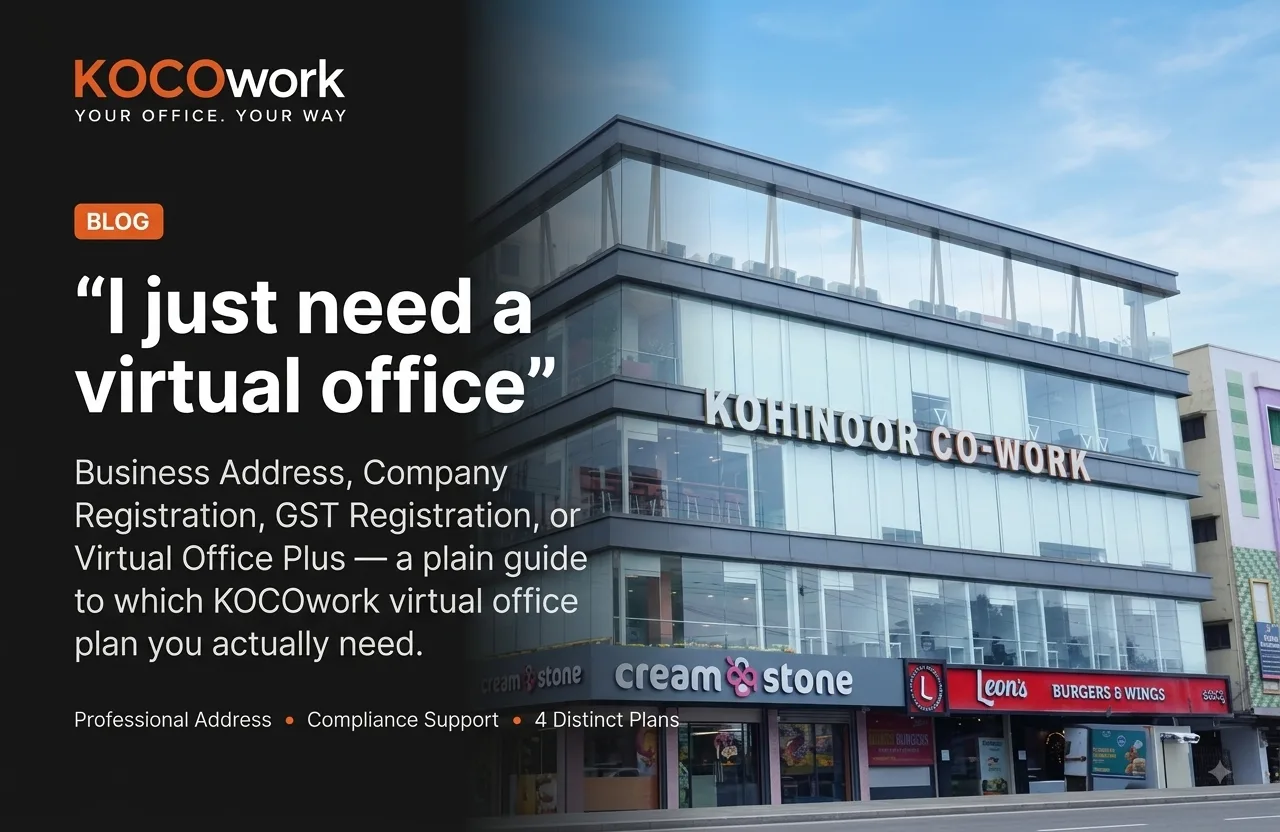
“I just need a virtual office” is one of the most common things founders say to us — and one of the least specific. A virtual office isn’t one thing. It’s four different plans, each solving a different problem, and most people only need one of them.
Buying the wrong one means either paying for compliance you don’t need yet, or missing compliance you actually do need. Here’s how to tell which plan is yours.
Why One-Size-Fits-All Virtual Office Plans Don’t Work
A freelancer who just wants a professional mailing address has a completely different requirement from a founder incorporating a private limited company, who has a different requirement again from an eCommerce seller registering GST across states. Bundling all three into a single “virtual office” plan means either overcharging the freelancer or undercharging the eCommerce seller relative to what they’re actually using.
KOCOwork’s Virtual Office plans are split by what they’re actually used for, not priced as a single generic bundle.
The Four Plans, Explained
| Plan | Price | Minimum Term |
|---|---|---|
| Business Address only | ₹999/month | None — cancel anytime |
| Company Registration | ₹999/month | 12 months |
| GST Registration | ₹1,499/month | 12 months |
| Virtual Office Plus (all combined) | ₹2,499/month | 12 months (24-month option available) |
Business Address Only
This is the simplest plan: a real, documented business address you can use for correspondence, invoicing, and general professional credibility — without registering anything through it. No minimum term, cancel anytime. It suits freelancers and consultants who already have their compliance sorted and just want a professional address to put on an invoice or a business card instead of a home address.
Company Registration
A registered office needs to be verification-ready — a real, checkable business address that satisfies MCA scrutiny without complications. This plan is built specifically for that filing, on a 12-month minimum term. It suits founders at the exact moment of incorporation who don’t yet need GST registration.
GST Registration
GST registration also requires a documented business address, and for many businesses — especially eCommerce sellers needing a VPOB or APOB in a state where they don’t have a physical office — this is the plan that unlocks it. Also a 12-month term, priced slightly above Company Registration to reflect the additional documentation GST filings typically require.
Virtual Office Plus (All Combined)
Most founders starting from zero need company registration and GST registration together, plus an address for ongoing correspondence. Rather than stacking two separate plans, Virtual Office Plus bundles all three into one plan at ₹2,499/month on a 12-month term, with a 24-month option available. This is the plan most new startups actually end up choosing, simply because most new startups need all three things in the same quarter.
Decision Framework
- Already registered, just need a professional address for invoices and mail? Business Address only.
- Incorporating a new company or LLP, no GST yet? Company Registration.
- Already incorporated, now need GST — especially for eCommerce or interstate selling? GST Registration.
- Starting from scratch and need incorporation, GST, and an ongoing address together? Virtual Office Plus.
What’s the Same Across All Four Plans
Every plan includes the documentation most registration processes require, and gives you access to KOCOwork’s day passes and meeting rooms at standard rates whenever you need physical space — to meet a client, sign documents, or simply get out of the house. None of the four plans require you to give up flexibility to get compliance.
Real Documents You’ll Actually Need
Regardless of which plan you land on, most registration processes ask for a similar core set of documents on your end: PAN details for the applicant or promoter, a bank account and recent statement, and authorized signatory proof if the business has more than one owner. The virtual office provider’s job is to supply the property side of that equation — the NOC, the rental agreement, and any address-verification documentation the specific filing requires.
It’s worth having these ready before you start, since the property-side paperwork typically moves faster than most people expect, and the applicant-side documents are usually what actually determines how quickly a filing goes through.
How Long Each Process Actually Takes
GST registration through a virtual office address typically takes 5–10 working days for standard approval, assuming the address documentation is in order and there’s no manual verification flagged. Company incorporation through the MCA’s SPICe+ process generally takes 7–14 days, factoring in document review and the government’s own processing timeline rather than anything specific to using a virtual address.
Neither timeline is meaningfully slower because the address is virtual rather than a leased office — what actually slows filings down is incomplete applicant-side documentation, not the nature of the registered address itself.
A Note on Switching Plans Later
None of these four plans lock you into that specific configuration forever. A founder who starts with Company Registration and later needs GST can add it; a business that starts with Virtual Office Plus and later needs to change its registered address to a physical office (once it leases one) can file that change with the MCA as a straightforward update. The virtual office plan is infrastructure for wherever you are right now, not a permanent commitment to one configuration.
Common Mistakes We See
The most frequent one is buying Virtual Office Plus by default, without checking whether Business Address or Company Registration alone would cover what’s actually needed right now — Plus makes sense when you need all three, but it’s not automatically the safest choice if you only need one.
The second most common: waiting until a GST deadline is close before registering, when the address and documentation could have been sorted weeks earlier with no urgency premium.
Who Typically Picks Each Plan
Patterns help here more than abstract rules. Business Address only tends to suit consultants and freelancers who registered their business a while ago and just need somewhere more credible than a home address to put on an invoice — no urgency, no filing deadline, just an upgrade to how the business presents itself.
Company Registration is the plan for the specific moment of incorporating — a founder who has decided to formalize a private limited company or LLP and needs the registered office address that filing requires, often before any revenue exists yet.
GST Registration shows up most often with eCommerce sellers expanding into a new state, or service providers crossing the turnover threshold that makes GST mandatory. It’s frequently added after a business has already been operating for a while, not at the very beginning.
Virtual Office Plus is the founder-from-scratch plan — someone who’s incorporating a company, registering for GST, and needs an ongoing address, all inside the same quarter. Bundling saves the friction of managing three separate relationships for what is, in practice, one connected compliance need.
Getting Started
Setup for any of the four plans is straightforward — share your documents, and the paperwork is handled from there, usually within a few working days.