Thought Leadership
Why the Design of Your Workspace Affects How You Actually Work
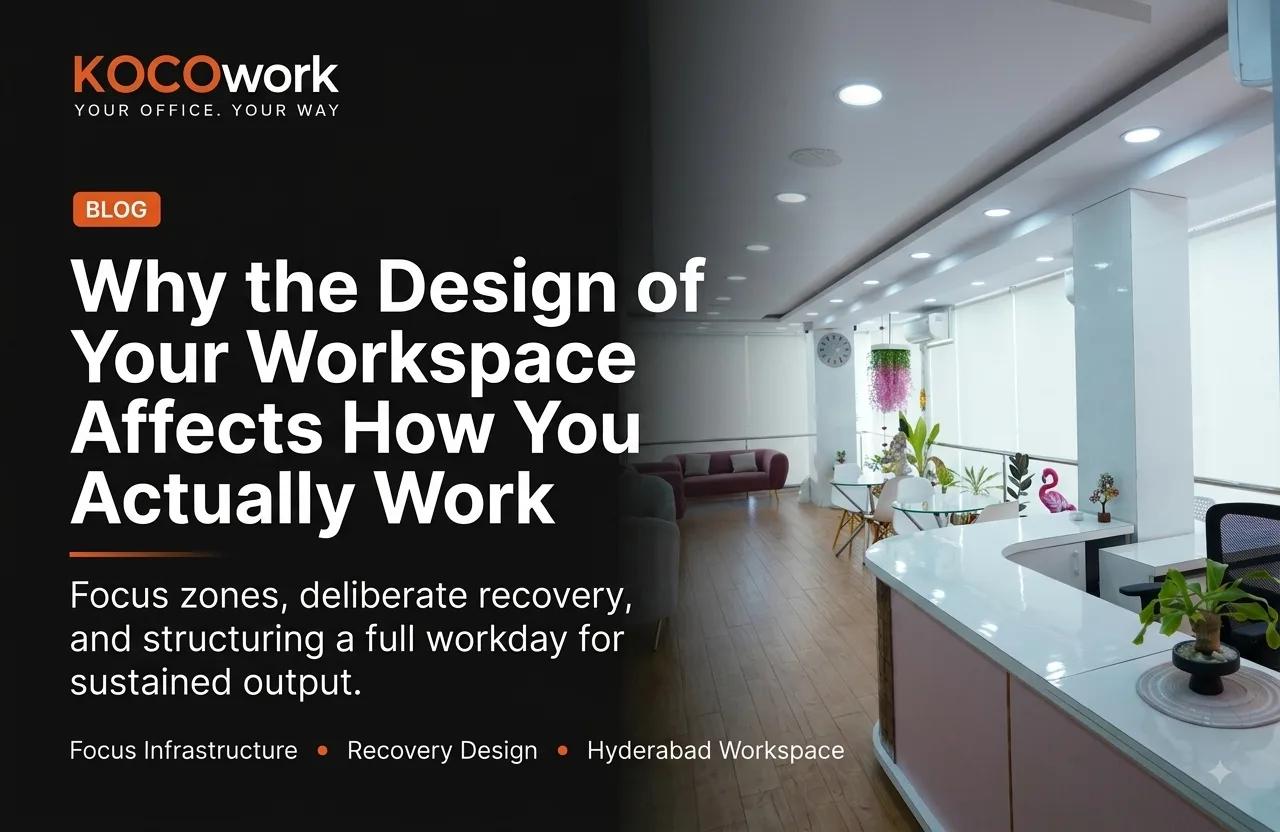
Most conversations about workspace focus on price and location. Fewer focus on something that affects output just as directly: how the space itself is designed to support an eight-hour workday.
Workplace research consistently links sustained output to structured work rhythms — periods of deep focus followed by deliberate recovery, rather than continuous, undifferentiated hours. A workspace that’s designed around this principle looks different from one that isn’t, and the difference shows up in how people actually feel by 4 PM.
The Two Modes Every Workday Needs
Every productive workday moves between two states: focused output and genuine recovery. Most workspaces are built to support only one of them.
Traditional offices tend to over-index on focus infrastructure — rows of desks, meeting rooms, little else — while treating breaks as something that happens at a desk, over a phone screen, or not at all. Home offices often have neither: no dedicated focus zone separate from daily life, and no deliberate recovery space beyond the same room you’ve been sitting in for six hours.
A workspace that’s actually designed for a full workday builds for both states on purpose.
What Focus-Oriented Design Actually Looks Like
- Reliable, fast connectivity — nothing breaks concentration faster than a dropped call or a spinning loading icon
- Seating options that match different focus needs — an open floor for collaborative energy, a quiet zone for heads-down work
- Minimal visual and audio clutter in the areas built for concentration
- Consistent access — the same desk or the same quality of seating, available when you need it, not first-come-first-served chaos
What Recovery-Oriented Design Actually Looks Like
- Physical activity options that don’t require leaving the building — table tennis, a walking pad, anything that gets you standing and moving for ten minutes
- A genuinely quiet space that’s different in feel from the focus zones — a library corner, not just a quieter desk
- Informal seating that invites conversation rather than more screen time
- Natural light and sightlines that don’t feel like an extension of the desk grid
Why Most Workspaces Get This Half Right
A café has neither. The noise level works against focus, and there’s no recovery option beyond ordering another coffee.
A traditional office usually has focus infrastructure and treats recovery as incidental — a break room with a vending machine isn’t recovery design, it’s a compliance requirement.
A home office has whatever your living space happens to include, which is rarely built for either state on purpose. The kitchen table is not a focus zone. The couch, twenty feet away, is not a deliberate recovery zone — it’s just the couch.
The Cost of Getting Workspace Design Wrong
Poor workspace design rarely shows up as a single dramatic failure. It shows up as accumulated small losses across a day: an extra fifteen minutes to mentally reset after a distraction that a genuine break space would have resolved in five, a client call taken from a noisy corner because there’s no quiet alternative nearby, an afternoon that trails off into low-quality work because there was nowhere to step away meaningfully.
None of these individually feels like a crisis. Added up across a working week, they represent a measurable gap between the output a space enables and the output the same person could produce somewhere better designed for a full day, not just the hours spent typing.
| Workspace Type | Focus Design | Recovery Design | Typical Gap |
|---|---|---|---|
| Home office | Inconsistent, competes with daily life | Usually absent | High — both dimensions ad hoc |
| Traditional office | Strong (desks, meeting rooms) | Weak (break room only) | Moderate — recovery undervalued |
| Café | Weak (noise, no privacy) | Absent | High — neither dimension supported |
| Design-first coworking space | Strong (open + quiet zones) | Strong (dedicated recreation, library) | Low — both dimensions deliberate |
The pattern holds across almost every workspace type we’ve observed: the places that treat recovery as an afterthought are usually the same places where focus quietly erodes over the course of a day, even though the two might look unrelated at first glance.
Why This Isn’t Just About Perks
It’s tempting to file recreation zones and libraries under “nice extras” — the kind of thing a workspace advertises but that doesn’t materially change anyone’s output. That framing misses what these spaces are actually doing functionally.
A ten-minute break spent in a genuinely different environment — different sounds, different posture, a brief social interaction or a moment of quiet — resets attention in a way that scrolling a phone at the same desk doesn’t. The physical change of environment is doing real cognitive work, not just providing entertainment. That’s the mechanism, and it’s why the distinction between “has a break room” and “has a deliberately designed recovery space” matters more than it sounds like it should.
What Members Actually Notice
Ask anyone who’s worked from both a traditional office and a design-first coworking space what they notice first, and it’s rarely the desk. It’s usually something closer to: “I don’t feel as drained by 5 PM,” or “I actually take breaks instead of just staring at my screen for a few minutes.” That’s the practical signal that the two-mode design is working as intended — not a claim about productivity in the abstract, but a difference people feel in how the day passes.
This is also why workspace design is worth evaluating directly rather than assuming any professional-looking space has thought it through. A space can have excellent desks and internet and still get recovery design wrong, or vice versa. The two need to be evaluated separately, because they solve different problems.
How KOCOwork Designs Around Both
At KOCOwork Champapet, this shows up as two deliberately different kinds of space, not a single floor plan doing double duty.
For focus: an Open Desk zone for collaborative energy, a Quiet Desk zone for low-distraction work, Dedicated Desk and Private Office options for teams that need consistency, and meeting rooms bookable by the hour when a conversation needs privacy.
For recovery: a recreation zone with table tennis, foosball, carrom, and board games, a library for quiet reading or calls, and a prayer room. None of these are positioned as perks bolted onto a membership — they’re built into the same floor as the desks, a few steps away rather than a separate trip.
A Quick Self-Check
If you’re evaluating your current setup — home, office, or another coworking space — a few questions can clarify whether it’s actually designed for a full workday, or just for the hours you’re at a desk.
- Is there anywhere to go besides your desk that isn’t a bathroom or a kitchen?
- If you needed ten minutes to reset your focus right now, would you have to leave the building?
- Does your workspace have a quiet zone that’s genuinely quiet, or just a quieter version of the same open floor?
- Would a client notice if a meeting happened in your “focus zone” versus a proper meeting room?
Most people answer no to at least one of these — not because their employer or landlord didn’t care, but because workspace design rarely gets treated as a deliberate decision rather than a byproduct of whatever space was available.
Why This Matters More as Work Gets More Flexible
Remote and hybrid professionals feel the absence of deliberate workspace design more acutely than anyone, precisely because no one else is designing their environment for them. A traditional employee inherits whatever design choices their office made. A freelancer or remote employee working from home makes every one of those choices by default, usually without realizing it — and usually not in favor of either sustained focus or genuine recovery.
This is one of the more underrated reasons professionals switch to coworking even when they don’t strictly need to leave home: it outsources the workspace-design decision to somewhere that’s already made it deliberately.
Design Is Infrastructure, Not Decoration
It’s easy to treat recreation zones, libraries, and quiet corners as nice-to-have extras — the kind of thing that shows up in a photo but doesn’t affect the actual workday. The research, and the pattern in how members actually use the space, suggests otherwise.
A workspace designed around both focus and recovery isn’t offering two separate amenities. It’s offering a more complete model of how sustained, high-quality work actually happens across a full day — not just during the hours you’re staring at a screen.